Metronome
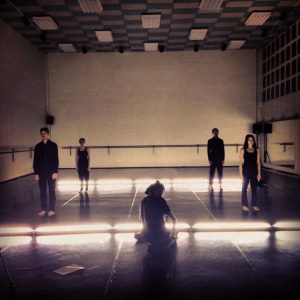
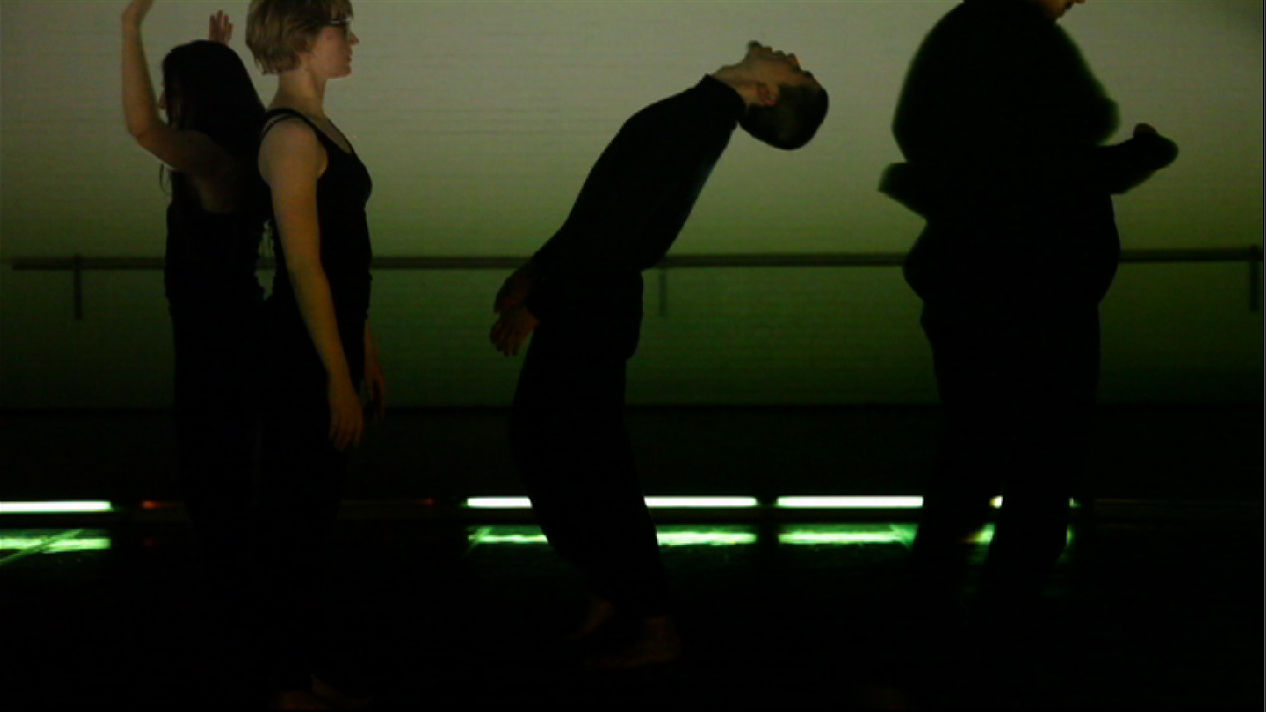
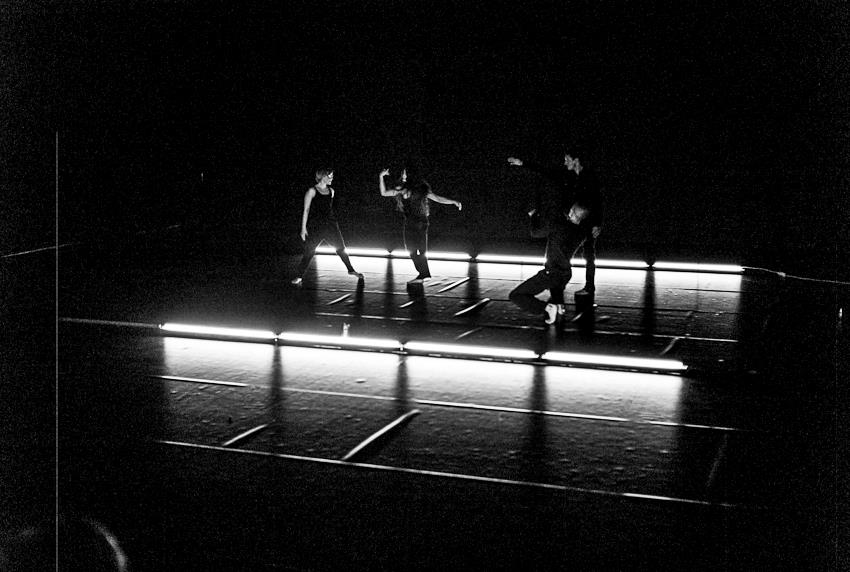
The metronome clicks and gives the pulse to the square-format stage. The lights are on. Four dancers are given rules to move according to the cycle of light. When the lights go off, the dancers move. When the lights come on again, they stop.
The sound of their movements is recorded through contact microphones attached to the floor. With delay, these sounds create different rhythms, all still guided by the continuous rhythm of the metronome.
Because we do not see the dancers’ movements, we begin to imagine them, as we only see their expressions during the still moments. What remains for us is to create our own understanding and contribute, through imagination, to their efforts and actions.
My Research Goals
My goal is to develop my project AFTERMATH, a contemporary dance work that I also consider a method. Aftermathwas first presented in 2012 as a work in progress at the Plataforma Berlin Festival, where I represented Brazil. The work had a duration of 10 minutes, but I would now like, together with my group, to further develop and investigate the project in order to reach a final format.
Aftermath as a Method
Having simple rules or regulations creates a certain frame and space for play, while a variety of topics and themes brings many possibilities for reflection and experimentation. Within the Aftermath method, however, the research must be played through to the end before the results can be analyzed.
When we go back in our minds to understand something in the present, it is often referred to as an aftermath — recalculations of something that has already taken place. History also changes every day, and so does our relationship to it.
Aftermath investigates time and tempo in order to create moments where something is hidden or silenced, so that we only see one “half,” while the other “half” we hear. Our connotations and assumptions create the story, and Aftermathultimately reflects on how our own perceptions shape the way we understand what we experience.
Our technical elements — sound, tempo and rhythm, together with light and darkness, also controlled through rhythm — create a metaphorical platform for producing a wide variety of re-enactments of life through contemporary dance.
The beginning of the project focused on exploring the technical possibilities: recording the floor and its sounds through contact microphones, and also recording the sounds of the lights switching on and off. We created different scores to generate group choreographies, with sound and light reacting in time.
I would like to expand this process and its challenges and develop it further as a narrative — a sequence of scenes carried through using these technical elements and the Aftermath method. The group already understands the method and its metaphorical possibilities, and new scenes and choreographies can be developed through research and improvisation.
Nice reflexion from Laura-Maria Heinz (Berlin Germany)
_170422_Hausarbeit_Das Phänomen Nähe und die Überbrückung von Distanz_Laura-Maria Heinz